
Retail and shopfront cleaning
They decide before
they walk in.
Shop and retail cleaning across the Northern Rivers and the Tweed. Floors, glass and the entry finished before you unlock the door, by the same local person every time. Easy to book, fast quoting, cost effective.
Get an instant quote
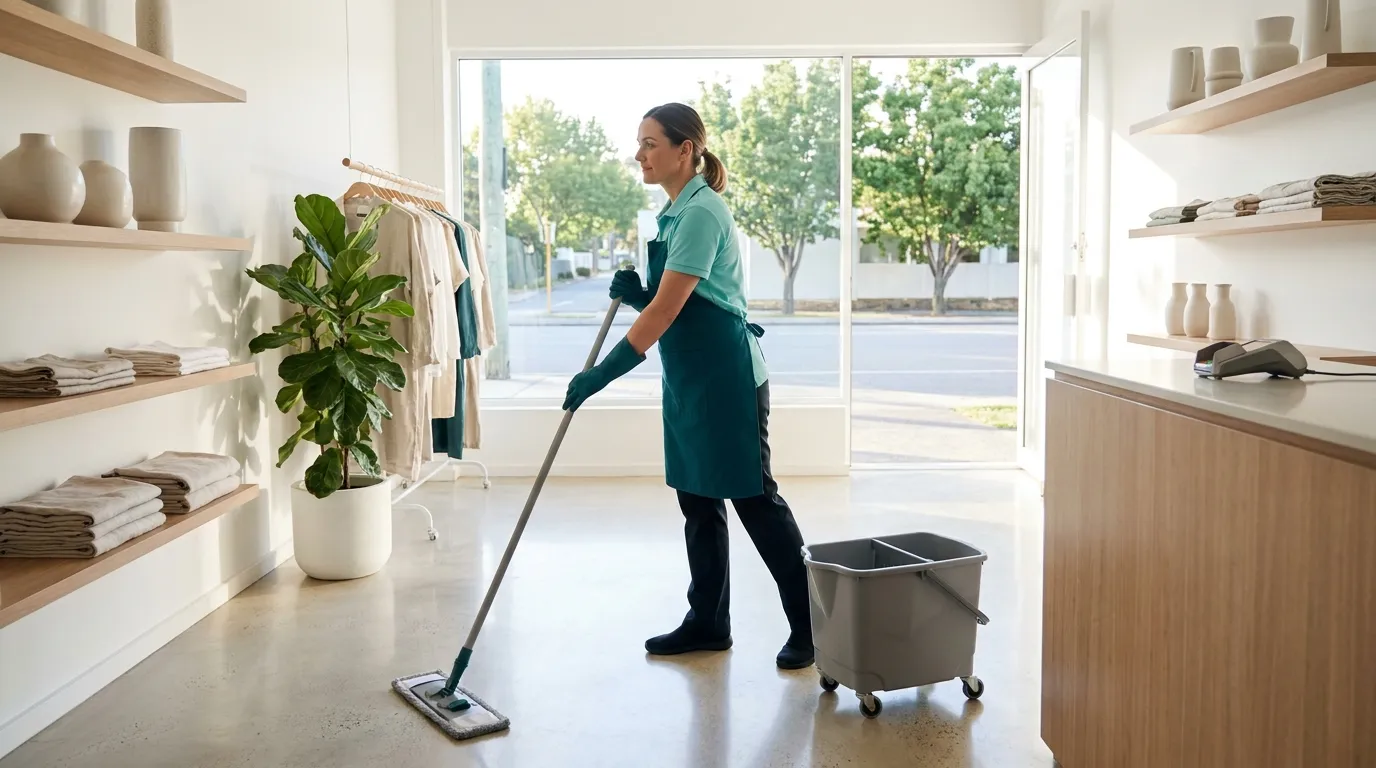
Retail cleaning is the daily cleaning of a shop or shopfront: floors, entry and matting, internal and external glass, the counter and fitting rooms, shelving and display surfaces, staff areas and the bathroom. TLB Cleaning does this work across the Northern Rivers and the Tweed for single shops, cafés and takeaway front of house, salons, galleries and strips of tenancies.
In retail the cleaning is part of the merchandising rather than maintenance, and the priority order is not what most people expect. Glass comes first, because a customer decides whether to come in from the footpath and the only thing between them and the stock is a pane of glass with the morning sun on it. Then the floor, then the entry, then the counter. Everything else is real work, but those four are what a browser reacts to before anyone has said hello.
What happens, and when
Ordered by the clock rather than by room, because that is the order a shop actually runs on.
- Before you openInternal glass and the entry doors done first, floors swept and mopped or vacuumed and dry before trade, entry matting lifted and cleaned underneath, counter and card terminal wiped, bins emptied and relined, fitting room mirrors and floors done. Finished and dry, not finished and wet with a sign out.
- External glass and the footpathShopfront glass outside as well as in, the frames and the threshold, and the footpath immediately outside swept. Coastal shopfronts collect salt film that fresh water alone will not shift, so the glass needs washing rather than wiping. Anything above ground level needs its own plan.
- Back of house, which nobody quotesStaff bathroom cleaned and restocked, kitchenette and sink, the stockroom floor swept and kept clear, and the bin area. The stockroom is the room a scope always leaves out and the room a health or fire inspection actually looks at, because a blocked exit path starts as a delivery nobody unpacked.
- Display surfaces, on your termsShelf and plinth surfaces dusted, mirrors and cabinet glass done, and the tops of fixtures nobody can see from the floor but everybody can see from the mezzanine. We do not move or restyle merchandise. We dust around it, or we dust it and put it back exactly as it was, and which of those it is goes on the scope rather than being assumed.
- Periodically, outside tradeCarpet extraction where there is carpet, hard floor machine scrubbing or polishing, high dusting and light fittings, air vents, and pressure cleaning the footpath and entry threshold. All of it booked into a closed day or an early morning, because none of it can happen with customers in the shop.
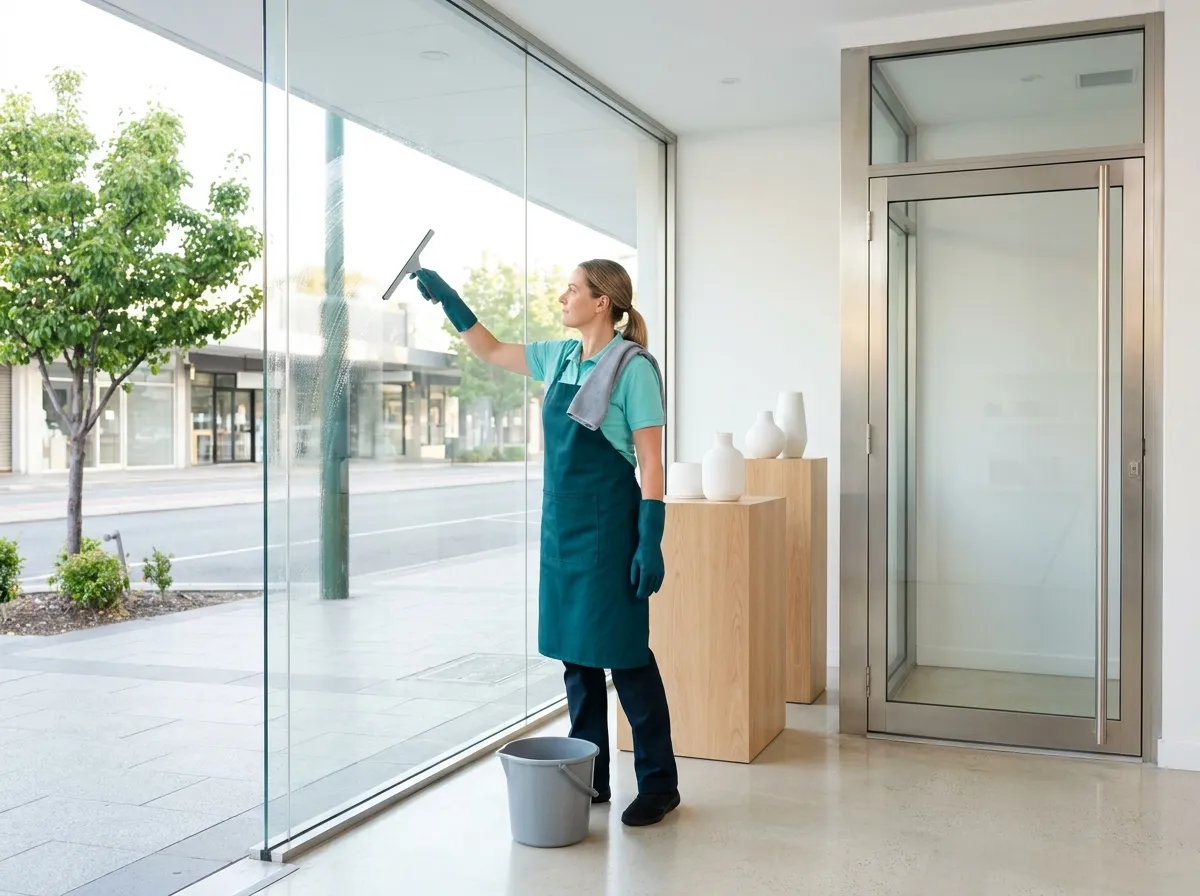 Glass first, every visit. It is the only thing between a browser on the footpath and your stock.
Check your lease before you buy any of this.
If your shop is inside a centre or a managed strip, the landlord’s cleaning contract usually covers the mall floor, the shared bathrooms, the loading dock and the common bin area, and you are already paying for it through outgoings. What it almost never covers is anything inside your lease line, which is your floor, your glass, your fitting rooms, your counter and your stockroom.
The two ways that costs a tenant money are opposite. Some pay for a scope that duplicates what outgoings already fund. Others assume the centre’s cleaner does their glass and never notice it has not been done in a year. Read the cleaning clause, or send it to us and we will quote to your lease line rather than over it.
The customers you lose never come in
The thing about a shop is that the people you lose never come in, so you never find out. A browser looks at your window from the footpath, and if the glass is streaked or fingerprinted or has last month’s tape residue on it, they read the whole business through it and keep walking. There is no complaint and no data. It is the only premises type in this cluster where the cost of poor cleaning is entirely invisible to the person paying for it.
That is also why glass is worth insisting on rather than treating as an extra. Coastal shopfronts in this region get a salt film that a dry cloth just smears, and the low morning sun on a main street shows every mark on it. Washed properly and squeegeed it disappears; wiped, it looks worse than before it was touched. If you only buy one line on the scope, buy that one, and buy it often enough that it is never a job someone has to notice.
Other premises we clean
Commercial cleaning for every kind of premises across the Northern Rivers and the Tweed.
- Office cleaning
- Strata and common area cleaning
- Aged care, retirement and seniors
- Medical, clinic and salon cleaning
- Construction site
- Hospitality, venues and holiday parks
- Commercial kitchen cleaning
- Schools and childcare centres
- Gyms and fitness studios
- Warehouses and industrial sites
- Factories
- Breweries
- Window cleaning
- Commercial carpet cleaning
- Commercial pressure cleaning
- Commercial cleaning
Where we clean
Across the Northern Rivers and the Tweed.
Northern Rivers NSW
- Lismore
- Goonellabah
- Alstonville
- Wollongbar
- Casino
- Kyogle
- Nimbin
- Clunes
- Bexhill
- Dunoon
- Ballina
- East Ballina
- Lennox Head
- Skennars Head
- Wardell
- Evans Head
- Broadwater
- Woodburn
- Coraki
- Bangalow
- Byron Bay
- Suffolk Park
- Mullumbimby
- Brunswick Heads
- Ocean Shores
- New Brighton
- Billinudgel
- Federal
The Tweed
- Murwillumbah
- Tweed Heads
- Tweed Heads South
- Banora Point
- Terranora
- Bilambil
- Bilambil Heights
- Chinderah
- Fingal Head
- Kingscliff
- Casuarina
- Cudgen
- Cabarita Beach
- Bogangar
- Hastings Point
- Pottsville
- Uki
- Burringbar
- Mooball
If a town isn't listed, ask us anyway.
Easy to book, fast quoting, cost effective
Managed for you. Set day, set team, a reminder before, a message on the way, and told first when something changes.
Book a walkthrough online, or send a text, ring us or email, whichever suits. We come and look at the premises rather than pricing it off a form.
Commercial work gets priced on the site, because hours on the ground are what set the number. You get a written scope and a price per visit, so you know what you're paying for. Anything outside that scope is quoted before it happens, not added afterwards.
It's cost effective because a written scope is something you can hold us to. You're buying a defined amount of work, on a set day, from the same team each visit. No lock-in term.
How it works
- Tell us about the job.
- We confirm the price and agree a time and access.
- We do the clean, and you get a message when we're on the way.
- If something needs fixing, you hear it from us first.
Frequently Asked Questions
1. Our shop is small. Is that too small for you?
No, and small shops are a lot of what this work is. What a small shop does run into is travel: a fifteen minute visit costs almost the same to get to as a forty minute one. Often the better answer for a small shop is three visits a week rather than five, and we will say so.
2. Can you be finished before we open?
Yes, and that is the whole point of an early visit. Floors dry, glass done, entry clear, before you unlock. A cleaner still working at trade is worse than no cleaner: you are paying for a service that is now costing you sales, and a wet floor sign in a doorway turns browsers around. If your opening time changes seasonally, tell us and the visit moves with it.
3. Do you do the windows too?
Internal glass is part of every retail scope. External shopfront glass at ground level needs washing rather than wiping in a coastal town because of salt film. Anything above ground level is a different job with different equipment, and we will tell you which yours is rather than quoting and then discovering it.
4. Will you touch our stock or displays?
Not unless you ask us to. The default is that we dust around merchandise and never move, restyle or reposition it, because a display someone spent an hour on is not ours to improve. If you would rather we lifted pieces to dust the plinth and put them back exactly as they were, we will, and that goes on the scope in writing so it is never a surprise either way.
5. What if we get a spill or a mess mid-trade?
Ring the local number. For clients on an ongoing scope we will get to a mid-trade problem the same day where we can, and tell you honestly if we cannot rather than leaving you waiting. Most retail messes are a fifteen minute job that becomes a real one if it dries, so it is worth calling early rather than mopping it with paper towel and hoping.
6. Do you take on a whole strip or a centre?
That is a different and larger conversation than a single shop, and it is the one case on this page where a site walkthrough genuinely pays for itself. If you manage a strip rather than trade from one, the strata and common area page is closer to what you need.
Retail Cleaning FAQs
1. How much does shop cleaning cost?
It depends on floor area and floor type, how much glass there is, whether external glass is included, and how many visits a week. That's why we quote rather than publish a flat rate that would be wrong for most shops. Tell us the basics and you'll have a price back quickly, with no obligation attached to it.
2. How often should a shop be cleaned?
Daily for anywhere with food, a fitting room or high foot traffic, and three times a week is usually enough for a low-traffic boutique or gallery. Glass is the exception and wants doing every visit regardless, because it is the surface customers judge from the footpath. Floors in a shop with a street entry get dirty faster than floor area suggests, since everything walks in from outside.
3. Who is responsible for cleaning in a retail lease, the tenant or the landlord?
Typically the landlord’s contract covers common areas — mall floors, shared bathrooms, the loading dock, common bin areas — and the cost is recovered from tenants through outgoings. Anything inside the lease line is usually the tenant’s: your floor, your glass, your fitting rooms, your stockroom. Leases vary, so the cleaning clause in your own lease is the answer rather than the general rule. Read it before you buy a scope.
4. Why does shopfront glass in a coastal town streak?
Because it is salt rather than dust. Sea air deposits a fine salt film that attracts moisture and cannot be removed by dry wiping — a cloth just moves it around and leaves a haze that shows badly in low morning sun. It needs washing with a detergent solution and squeegeeing off, the same way a professional does a window, which is why wiped shopfront glass often looks worse afterwards than before.
5. Should a shop floor be cleaned during trading hours?
Only for spills. A routine clean during trade creates a slip hazard exactly where your customers are, and slips are among the most common causes of injury in retail workplaces. It also reads badly: a mop and bucket in a doorway turns browsers away more effectively than almost anything else. Routine cleaning belongs before opening or after close, with mid-trade attention reserved for genuine spills.
6. What is usually left out of a retail cleaning quote?
Four things, consistently: external glass, under the entry matting, the stockroom floor, and the tops of fixtures. All four are invisible on the day and all four are noticed within a month. The stockroom is the one worth insisting on, because a stockroom that is never cleaned becomes a stockroom with a blocked exit path, and that is a fire and work health and safety problem rather than a tidiness one.
Retail and shopfront cleaning
Send us your floor plan or your lease clause.
For a single shop we can quote from that and a few photos. For a bigger store or a strip of tenancies, a walkthrough is worth the twenty minutes.