
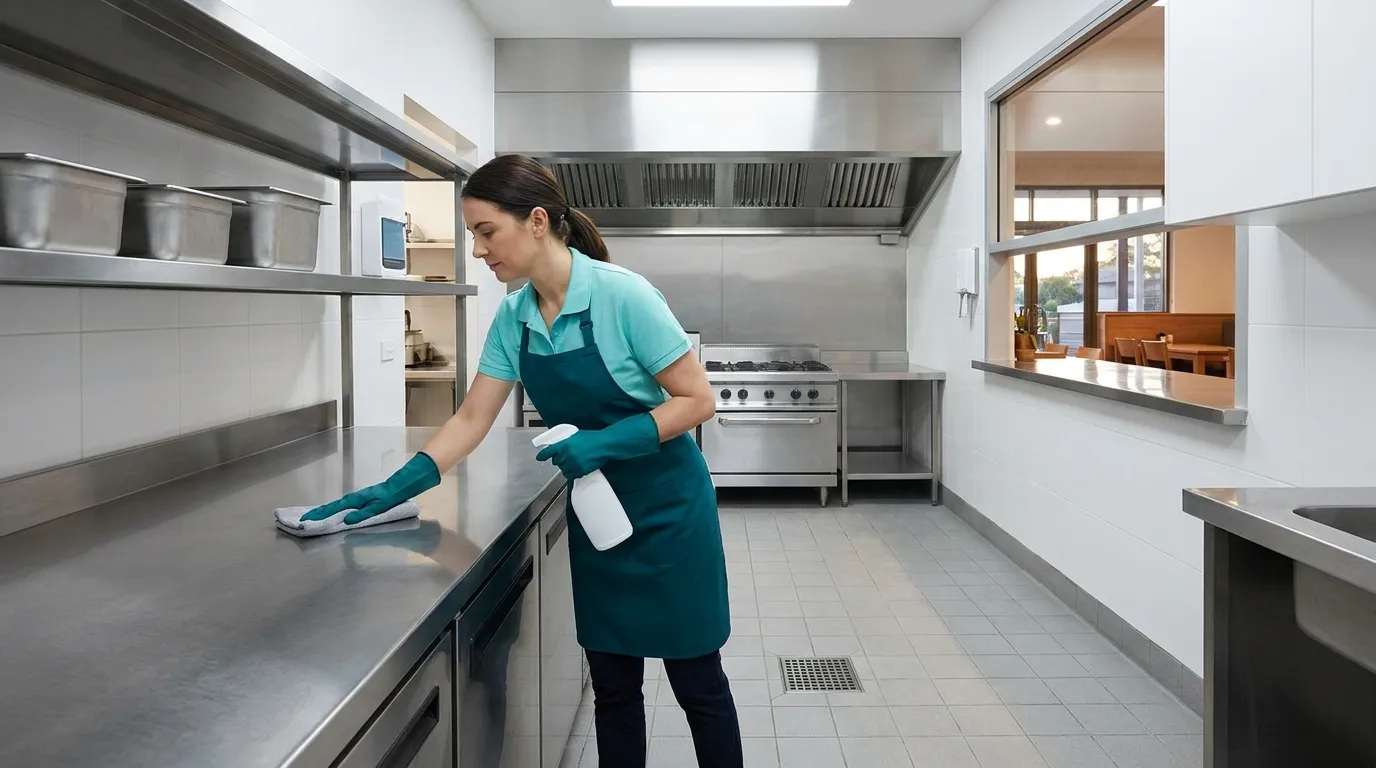
Commercial kitchen cleaning
Commercial kitchen cleaning services
for cafes, pubs and restaurants
Commercial kitchen cleaning services done between services, not during them
Your brigade cleans nightly. This is the other clean. Behind the equipment, under the benches and into the drains, across the Northern Rivers and the Tweed, on the visit that needs the kitchen cold and the line pulled out. Easy to book, fast quoting, cost effective.
Get a quote
Commercial kitchen cleaning is the periodic deep cleaning of a professional kitchen: floors and drains, walls and splashbacks, the sides and backs of equipment, under and behind the cooking line, cool room interiors and the stainless nobody can reach mid-service. TLB Cleaning does this work across the Northern Rivers and the Tweed, scheduled around your trading.
It is not the nightly close-down, and confusing the two is how kitchen quotes end up impossible to compare. Your brigade cleans as they go and closes down the line every night, because food contact surfaces and equipment are part of running a kitchen and cannot wait for a contractor. What a contractor is for is the work that needs the kitchen cold, the equipment pulled out and four uninterrupted hours: the parts that get worse every week until someone books them.
A canopy clean and a canopy certificate are not the same purchase.
Cleaning a kitchen exhaust system properly means the filters, the hood, the plenum and the ductwork all the way to the fan, done to the maintenance requirements in AS/NZS 1668.1, and it finishes with a report and a certificate you keep. That document is the point. Your insurer or your landlord will ask for it after a grease fire, and a kitchen that cannot produce one is in a much worse position than a kitchen that can.
Plenty of cleaners will degrease the visible underside of your canopy and call it a canopy clean. It is not dishonest work, it is just not the thing that protects you, and it leaves the grease that actually matters sitting in the duct above the ceiling. So ask any quote one question: does this come with a certificate. If the answer is no, you still need the certified clean on top of it, and you should know that before you pay for either.
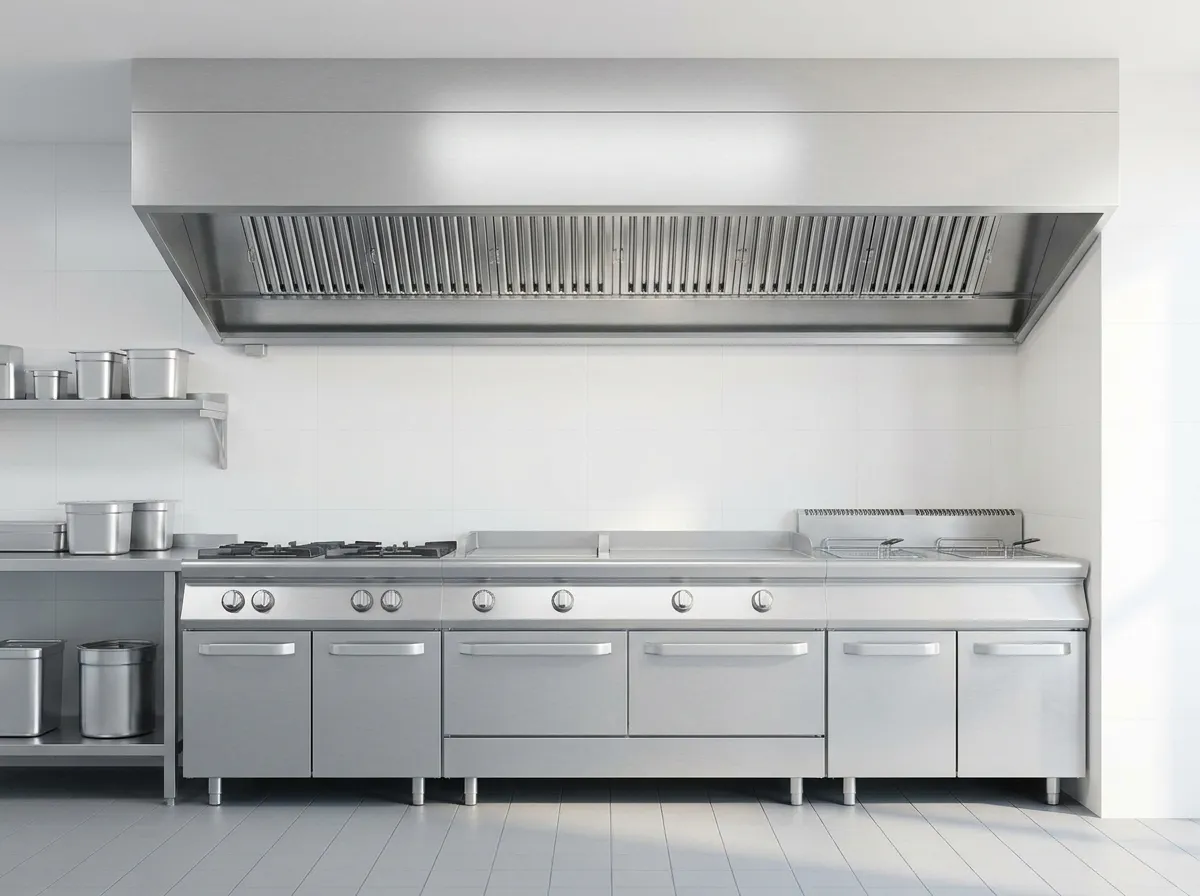 Filters and canopy, degreased and refitted. The ductwork above this is a certified trade, and a different invoice.
Three trades, routinely confused
Booking the wrong one costs you a compliance document, which is worse than paying too much.
Periodic deep cleaning
Us. Floors, drains, walls, behind and under the line, cool rooms, stainless. Booked monthly or quarterly, done between services. No certificate, because none exists for this work — what you get is a written scope and a kitchen you can see the difference in.
Certified exhaust cleaning
A specialist. Filters, hood, plenum and the full ductwork to the fan, to the maintenance requirements in AS/NZS 1668.1, with a report and a certificate for your records and your insurer. Frequency depends on how much you fry. Ask us and we will give you a name.
Grease trap servicing
A licensed liquid waste contractor. Pump-out, disposal and the tracking paperwork, usually on a schedule set by your local council or water authority. Not a cleaning job at all, and not something a general cleaner can legally take away for you.
A kitchen never looks dirty to the people in it
A kitchen never looks dirty to the people in it. It degrades a millimetre at a time, on every surface at once, and the brigade adapts around it without noticing: the gap behind the fryer, the grout that has gone from grey to black, the cool room seal that has started to spot. Then a council inspector arrives, or a new head chef starts, or somebody slips, and all of it is visible in one afternoon.
Two things make the frequency worth arguing about rather than the price. The first is that grease is a fire load: what accumulates in and above an exhaust system is what turns a flare-up into a building fire, and it is the reason exhaust cleaning intervals are set by how much you fry rather than by the calendar. The second is that under the Food Standards Code your premises, fixtures, fittings and equipment have to be kept clean and sanitary, and a periodic deep clean on a schedule is how a kitchen demonstrates that instead of asserting it. Book it monthly or quarterly and it stays a cleaning line item. Leave it and it becomes a capital one.
Other premises we clean
Commercial cleaning for every kind of premises across the Northern Rivers and the Tweed.
- Office cleaning
- Strata and common area cleaning
- Aged care, retirement and seniors
- Medical, clinic and salon cleaning
- Construction site
- Hospitality, venues and holiday parks
- Schools and childcare centres
- Gyms and fitness studios
- Retail and shopfronts
- Warehouses and industrial sites
- Factories
- Breweries
- Commercial carpet cleaning
- Commercial pressure cleaning
- Commercial cleaning
Where we clean
Across the Northern Rivers, the Tweed and the Southern Gold Coast.
Northern Rivers NSW
- Lismore
- Goonellabah
- Alstonville
- Wollongbar
- Casino
- Kyogle
- Nimbin
- Clunes
- Bexhill
- Dunoon
- Ballina
- East Ballina
- Lennox Head
- Skennars Head
- Wardell
- Evans Head
- Broadwater
- Woodburn
- Coraki
- Bangalow
- Byron Bay
- Suffolk Park
- Mullumbimby
- Brunswick Heads
- Ocean Shores
- New Brighton
- Billinudgel
- Federal
The Tweed
- Murwillumbah
- Tweed Heads
- Tweed Heads South
- Banora Point
- Terranora
- Bilambil
- Bilambil Heights
- Chinderah
- Fingal Head
- Kingscliff
- Casuarina
- Cudgen
- Cabarita Beach
- Bogangar
- Hastings Point
- Pottsville
- Uki
- Burringbar
- Mooball
Southern Gold Coast QLD
- Coolangatta
- Bilinga
- Tugun
- Currumbin
- Palm Beach
- Elanora
- Burleigh Heads
- Burleigh Waters
- Miami
If a town isn't listed, ask us anyway.
Easy to book, fast quoting, cost effective
Managed for you. Set day, set team, a reminder before, a message on the way, and told first when something changes.
Book a walkthrough online, or send a text, ring us or email, whichever suits. We come and look at the premises rather than pricing it off a form.
Commercial work gets priced on the site, because hours on the ground are what set the number. You get a written scope and a price per visit, so you know what you're paying for. Anything outside that scope is quoted before it happens, not added afterwards.
It's cost effective because a written scope is something you can hold us to. You're buying a defined amount of work, on a set day, from the same team each visit. No lock-in term.
How it works
- Tell us about the job.
- We confirm the price and agree a time and access.
- We do the clean, and you get a message when we're on the way.
- If something needs fixing, you hear it from us first.
Booking a kitchen deep clean
1. When would you actually be in the kitchen?
After your last service or before your first prep, and for a full deep clean usually overnight or on your closed day. A kitchen has to be cold and the line has to be pulled out, neither of which is possible between lunch and dinner. Tell us your trading pattern at the walkthrough and we will fit the visit into the only gap that genuinely exists.
2. Do you do the canopy and the ducts?
Not the ducts. Certified exhaust cleaning finishes with a report and a certificate for your insurer, and only a specialist can issue that. Ask us and we will give you a name instead of a quote.
3. How often should we book a deep clean?
Monthly for a kitchen with a busy fryer and grill, quarterly for a café or a kitchen doing mostly cold and oven work. What sets it is how much you fry rather than how many covers you do, because oil in the air is what lands on every surface in the room. A walkthrough settles it in ten minutes, and we would rather quote you quarterly and be right than monthly and be greedy.
4. Do we have to empty the cool room first?
Stock movement should stay with your team, for food safety reasons rather than for convenience: your staff know what can leave a cool room and for how long, and we do not. In practice we book cool room work for the morning after a delivery gap, so there is less in there to move.
5. What chemicals do you use in a food area?
Food-safe products where surfaces are food contact, and heavy degreasers only on floors, walls and equipment exteriors where they can be rinsed off properly. Everything is rinsed rather than left to dry on a surface food will touch, and nothing gets used near open stock. If your food safety program specifies particular products, yours wins and it goes on the scope.
6. What happens if I get in touch?
We walk the kitchen when it is cold, look behind the line and lift a floor grate, and tell you what is actually there. Then you get a written scope, a price per clean and a recommended interval. If what you really need is a certified exhaust clean, we will say so and point you at someone who can issue the certificate.
Commercial Kitchen Cleaning FAQs
1. How much does commercial kitchen cleaning cost?
The price of a periodic deep clean moves with the size of the cooking line, how much of the equipment has to be pulled out, the floor area of quarry tile, whether cool rooms are included and how long it has been since the last one. The first clean on a kitchen that has never had one is always the biggest. That's why we quote rather than publish a flat rate that would be wrong for most kitchens. Tell us the basics and you'll have a price back quickly, with no obligation attached to it.
2. How often does a commercial kitchen need deep cleaning?
Monthly for a high-volume kitchen with fryers and a chargrill, quarterly for lighter cooking. The driver is airborne oil rather than covers: frying and grilling put grease into the air that settles on every surface in the room, including ones nowhere near the line. Exhaust systems are on their own interval, set by cooking type and hours rather than by a fixed calendar date.
3. What are the legal cleaning requirements for a commercial kitchen in Australia?
Food businesses must keep premises, fixtures, fittings and equipment in a clean and sanitary condition under the Food Standards Code, and local councils inspect against it. The Code sets the outcome rather than a task list, so your own food safety program is what documents how you meet it. Exhaust systems have separate maintenance requirements under AS/NZS 1668.1. This is general information, not compliance advice — your council is the right source for your premises.
4. Who is responsible for cleaning a commercial kitchen, staff or a contractor?
Both, and the split should be written down. Kitchen staff clean as they go and close the line down nightly, because food contact surfaces and equipment cannot wait for a contractor. A cleaning contractor does the periodic work that needs the kitchen cold and the equipment moved. Where a scope does not say which is which, the gaps are always the same ones: behind the line, the floor grates and the cool room seals.
5. Why does kitchen exhaust cleaning need a certificate?
Because the accumulated grease in a hood and its ductwork is a fire load, and the certificate is what shows it was removed to the required standard and when. Insurers and landlords commonly ask for that evidence, and after a grease fire the absence of it is a problem. A visible degrease of the underside of a canopy is useful cleaning but it does not address the duct and it does not produce the document.
6. Can a cleaner empty a grease trap?
No. Grease trap waste is regulated liquid waste and it has to be pumped out, transported and disposed of by a licensed contractor with the tracking paperwork that goes with it, usually on a schedule set by your local water authority or council. A general cleaning contractor can keep the surrounds clean and tell you when a trap is close to needing service, and that is the extent of it.
Commercial kitchen cleaning
We will look behind the line.
A walkthrough while the kitchen is cold, a lifted floor grate, and an honest answer about what is actually there. Then a written scope, a price per clean and a recommended interval. Get a quote.