
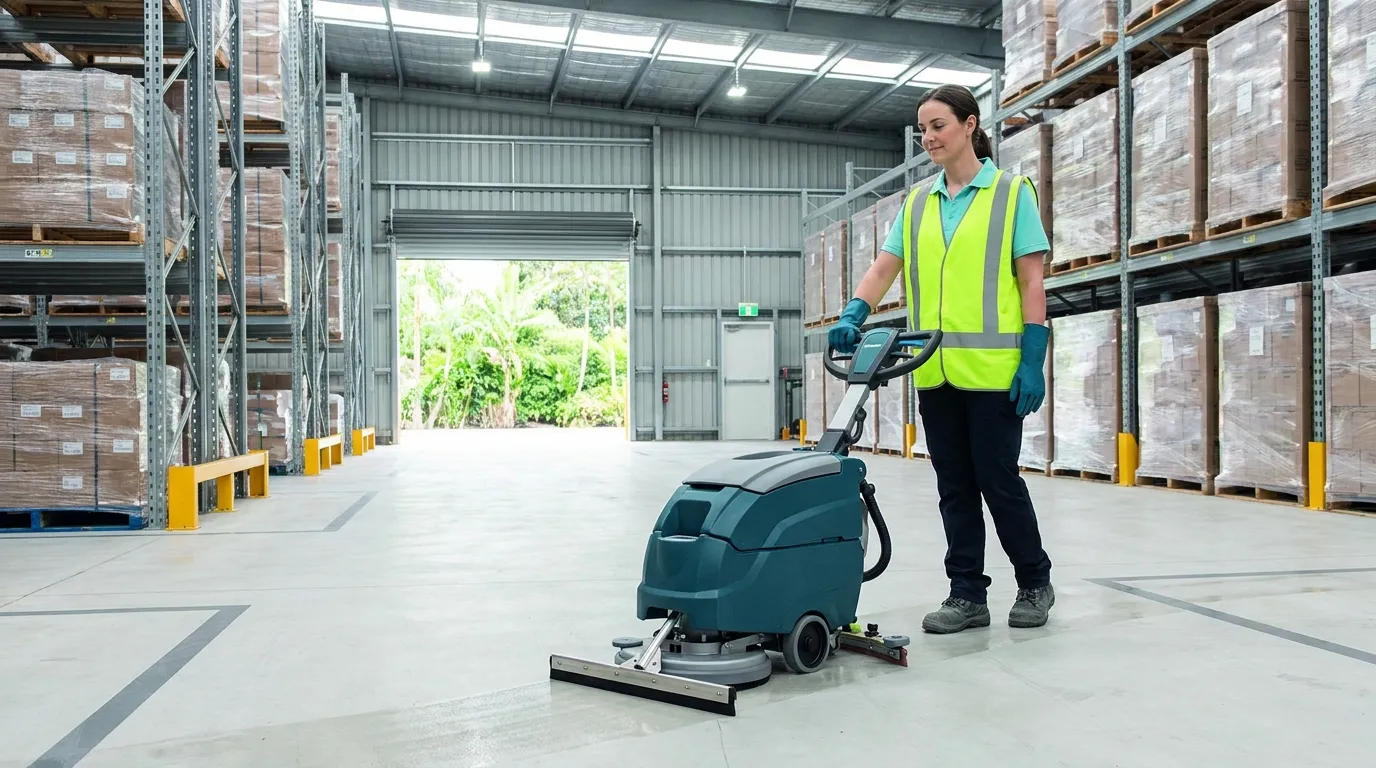
Warehouse and industrial cleaning
Commercial warehouse cleaning services
across the Northern Rivers and the Tweed
Commercial warehouse cleaning services priced by zone, floor and amenities separately
A concrete floor is not a mopping job. Aisles machine scrubbed, racking and docks cleared, the crib room and bathrooms done daily, and a written scope that says which is which. Easy to book, fast quoting, cost effective.
Talk to us about your site
Commercial warehouse cleaning services cover the scheduled cleaning of a storage, distribution or light-industrial site: the floor and aisles, racking and shelving, the loading dock and hardstand, mezzanine offices, and the crib room, bathrooms and locker areas your team uses every shift. TLB Cleaning does this work across the Northern Rivers and the Tweed.
It is two jobs in one contract and they have almost nothing in common. The floor is a machine job on a large area with a forklift moving through it, priced on square metres and access. The amenities are a small, detailed, daily job priced on fixtures. Quotes get compared badly because one contractor has assumed the amenities are included and another has not, so the useful thing to settle first is which of the two you are actually buying.
Four things we will say no to, and you should want us to.
Working at height. Dusting the top of racking, cleaning high-bay light fittings or getting to the underside of a roof needs an elevating work platform and the training and licensing that goes with operating one, plus a fall-prevention plan for the site. Driving your forklift or a reach truck to get us up there is not a workaround; that needs a high risk work licence.
Racking inspection, and spills of anything we cannot identify. A cleaner who notices a bent upright should tell you, and ours will, but a racking inspection is an engineering assessment and no cleaning contract substitutes for one. And if something has leaked and nobody can tell us what it is, we stop and we come and find you. Your emergency procedure and the Safety Data Sheet decide what happens next, not a mop and a guess. A contractor who cleans it up anyway is doing you harm with good intentions.
The two zones every quote thins out
Both are small against the floor. Both are what your team and your visitors actually judge the site on.
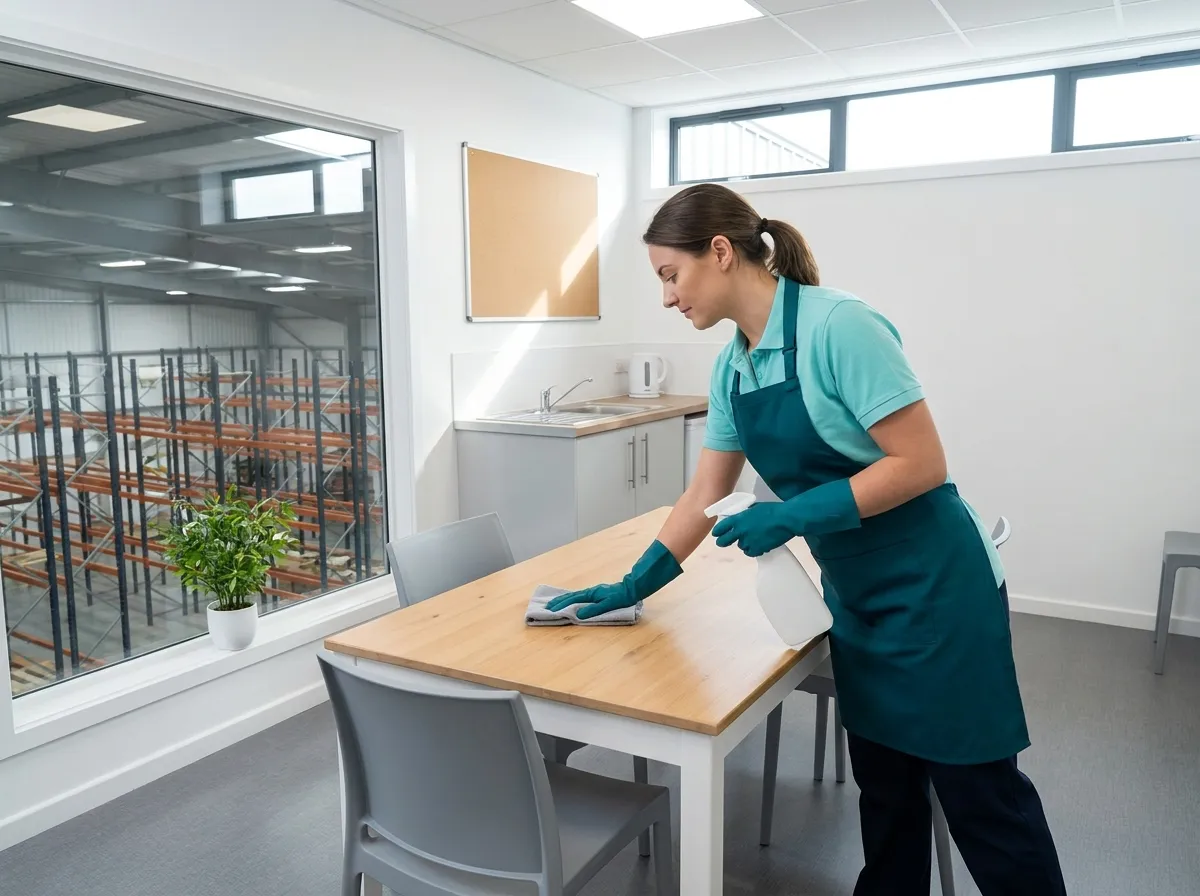
The crib room is not the small line
On a warehouse quote the amenities are usually a rounding error against the floor, so they are the first thing trimmed when a price needs to come down. Then they are cleaned three times a week instead of daily, and within a month the crib room is the thing your team talks about. Nobody complains about the floor. They complain about the microwave, the bathroom, and the fridge nobody has emptied since March.
That matters more on an industrial site than almost anywhere, because the amenities are the entire non-working experience of the shift. A picker spends eight hours in a space with no windows and one room to eat in. Cleaning that room properly, every day, is one of the least expensive retention levers on the site, and it costs a fraction of what the floor does.
The dock is where your housekeeping is judged
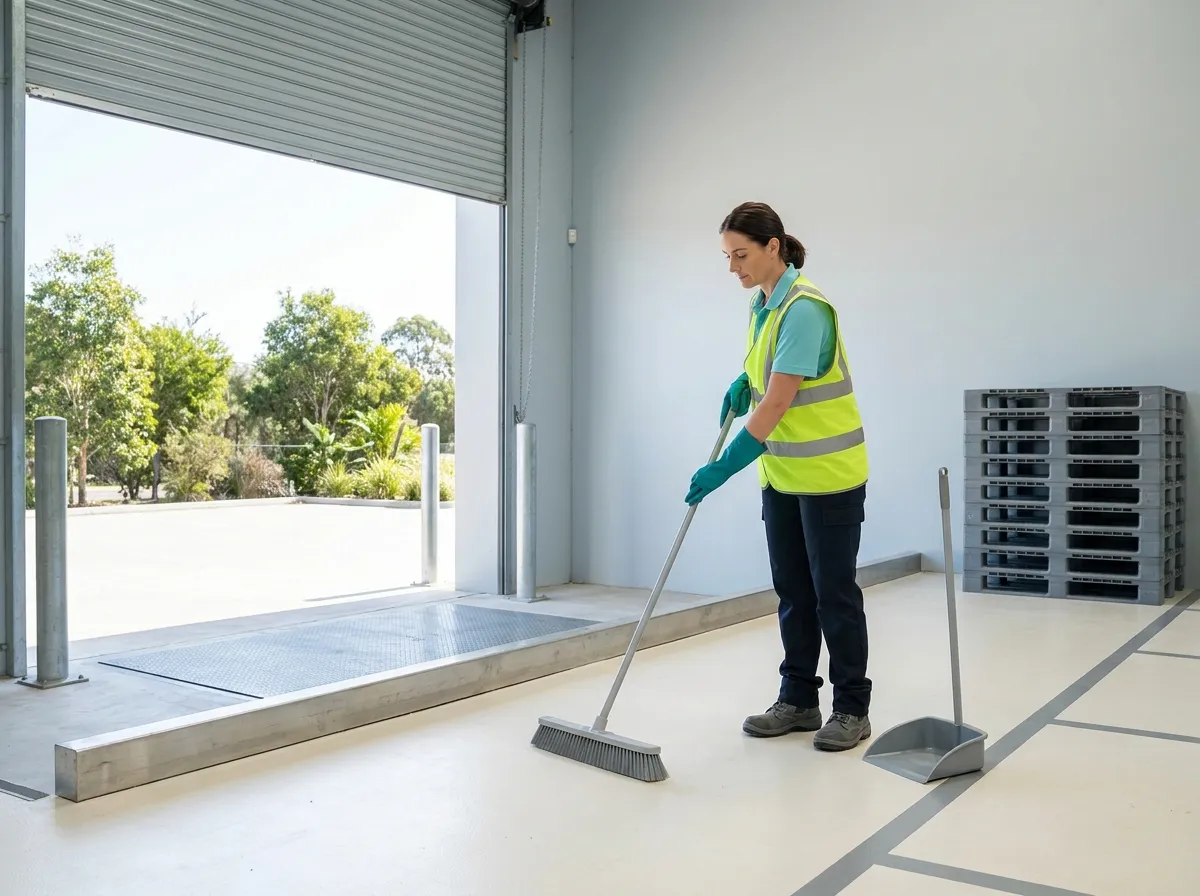
The other zone that gets under-scoped is the dock, and it is the one every visitor sees. Drivers, customers, auditors and your own insurer form a view of how the site is run from the state of the apron: whether there is pallet wrap blowing around, whether the drains are clear, whether the edge plate is buried under debris.
It is also a genuine safety zone rather than a presentation one. Strapping and wrap on a dock floor is a slip and a trip hazard in the one place on site where people work alongside moving vehicles, and a blocked drain on an apron in this region means water across that same floor within an hour of a storm.
A machine-scrubbed floor is a floor with more grip
A warehouse floor is a safety item, not a presentation one, and that changes who should be signing off the cleaning scope. Slips and trips are among the most common causes of workplace injury in the country, and on a concrete floor the mechanism is almost always the same: a film of tyre rubber, dust and moisture that a mop spreads rather than removes, in a building where people walk alongside forklifts. A machine-scrubbed floor is not a tidier floor. It is a floor with more grip.
Dust does two things worth budgeting for. In the wrong setting — timber, grain, flour, some plastics and metals — accumulated combustible dust on racking and roof structure is a recognised fire and explosion risk, and it is exactly the dust nobody can reach without an EWP. Everywhere else it is quieter and slower: abrasive dust and tyre rubber ground into sealed concrete shortens the life of the seal, and re-sealing a warehouse floor is a capital job that comes out of a different budget than cleaning does. A business has a duty to provide and maintain a work environment without risks to health and safety, and on an industrial site housekeeping is a large part of how that duty is actually met.
Other premises we clean
Commercial cleaning for every kind of site across the Northern Rivers and the Tweed.
- Office cleaning
- Strata and common area cleaning
- Aged care, retirement and seniors
- Medical, clinic and salon cleaning
- Construction site
- Hospitality, venues and holiday parks
- Commercial kitchen cleaning
- Schools and childcare centres
- Gyms and fitness studios
- Retail and shopfronts
- Factories
- Breweries
- Commercial carpet cleaning
- Commercial pressure cleaning
- Commercial cleaning
Where we clean
Across the Northern Rivers, the Tweed and the Southern Gold Coast.
Northern Rivers NSW
- Lismore
- Goonellabah
- Alstonville
- Wollongbar
- Casino
- Kyogle
- Nimbin
- Clunes
- Bexhill
- Dunoon
- Ballina
- East Ballina
- Lennox Head
- Skennars Head
- Wardell
- Evans Head
- Broadwater
- Woodburn
- Coraki
- Bangalow
- Byron Bay
- Suffolk Park
- Mullumbimby
- Brunswick Heads
- Ocean Shores
- New Brighton
- Billinudgel
- Federal
The Tweed
- Murwillumbah
- Tweed Heads
- Tweed Heads South
- Banora Point
- Terranora
- Bilambil
- Bilambil Heights
- Chinderah
- Fingal Head
- Kingscliff
- Casuarina
- Cudgen
- Cabarita Beach
- Bogangar
- Hastings Point
- Pottsville
- Uki
- Burringbar
- Mooball
Southern Gold Coast QLD
- Coolangatta
- Bilinga
- Tugun
- Currumbin
- Palm Beach
- Elanora
- Burleigh Heads
- Burleigh Waters
- Miami
If a town isn't listed, ask us anyway.
Easy to book, fast quoting, cost effective
Managed for you. Set day, set team, a reminder before, a message on the way, and told first when something changes.
Book a walkthrough online, or send a text, ring us or email, whichever suits. We come and look at the premises rather than pricing it off a form.
Commercial work gets priced on the site, because hours on the ground are what set the number. You get a written scope and a price per visit, so you know what you're paying for. Anything outside that scope is quoted before it happens, not added afterwards.
It's cost effective because a written scope is something you can hold us to. You're buying a defined amount of work, on a set day, from the same team each visit. No lock-in term.
How it works
- Tell us about the job.
- We confirm the price and agree a time and access.
- We do the clean, and you get a message when we're on the way.
- If something needs fixing, you hear it from us first.
Booking a warehouse clean
1. Can your team meet our site induction?
They have to, and it should be a condition of the contract rather than a formality. Most industrial sites require a site-specific induction, a sign-in, high-visibility clothing and safety footwear as a minimum, and some require more. Tell us your requirements at the walkthrough and we will tell you honestly what we hold.
2. When would you be on site, if we run two shifts?
In whatever gap genuinely exists, and if there is not one, zone by zone around live work. Amenities can be done between shifts because they empty out. Floor scrubbing needs an aisle with nothing moving in it, so it gets done aisle by aisle in your quietest window rather than in one pass. If you run around the clock, the floor becomes a weekend or shutdown job and we will say so rather than promise a nightly pass.
3. Do you do the floor with a machine?
That is the right question to ask every contractor quoting you, because it is the difference between a service and an appearance. A mop and bucket on a warehouse floor moves the tyre rubber and dust film around instead of lifting it, which is why a mopped concrete floor can look wet-clean and still be slippery.
4. Can you work around forklifts?
We work around them by not being in the same aisle at the same time, which is a scheduling answer rather than a bravery one. Our team stays in pedestrian walkways, wears high-visibility clothing, and clears an aisle with your supervisor before working in it. What we will not do is drive your plant, ride on it, or work under a raised load. None of those are negotiable.
5. Will you clear the pallet wrap and strapping?
Yes, that is part of the dock and floor scope, and it is one of the best-value lines on it: wrap and strapping on a floor is a trip hazard in the one part of the site where people and vehicles share space. Where it goes matters though. It gets bagged and put in your waste stream, and if you want it taken off site or separated for recycling, that goes on the scope with its own price.
6. What happens if I get in touch?
We walk the site with you and look at four things: the floor and how much of it a machine can actually reach, the racking, the dock, and the crib room and bathrooms. Then you get a written scope split by zone with a frequency against each, a price per visit, and the periodic work booked to a shutdown. No obligation.
Warehouse Cleaning FAQs
1. How much does warehouse cleaning cost?
A good quote shows the floor and the amenities separately, so you can see what you are buying. The price moves with how much of the floor a machine can actually reach around racking and stock, how many bathrooms and crib rooms there are, whether the dock and hardstand are included, and whether there is a gap in your shifts. That's why we quote rather than publish a flat rate that would be wrong for most sites. Tell us the basics and you'll have a price back quickly, with no obligation attached to it.
2. How often should a warehouse floor be cleaned?
Aisles and pedestrian walkways weekly to fortnightly for a normal storage site, and daily to weekly for a busy distribution centre or anywhere handling food. The driver is forklift traffic rather than floor area, because tyre rubber and the dust it grinds in are what actually build up. Amenities and bathrooms are daily regardless of how quiet the floor is.
3. Why use a floor scrubber instead of a mop?
Because a mop and a scrubber do different things. A scrubber applies solution, agitates the floor with a brush or pad, and vacuums the dirty water straight back off, so the soil leaves the building. A mop puts solution down, moves the soil around in it, and leaves most of it behind in a thin film as the floor dries. On a large sealed concrete floor that film is what makes a "clean" floor slippery.
4. Is warehouse cleaning a work health and safety requirement?
Not as a named task, but the outcome is. A business has a primary duty under the model work health and safety laws to provide and maintain a work environment without risks to health and safety, and on an industrial site housekeeping is a large part of how that is met: clear walkways, floors with grip, dock aprons without trip hazards, drains that are not blocked. Your regulator, SafeWork NSW, is the right primary source. This is general information, not safety advice.
5. Is dust in a warehouse a fire risk?
It can be, and it depends what the dust is. In sites handling timber, grain, flour, sugar, some plastics and some metals, accumulated combustible dust on racking, ledges and roof structure is a recognised fire and, in the right conditions, explosion risk. In a general storage warehouse it is a pest and product-contamination issue rather than a fire one. Either way the dust that matters most is usually the dust nobody can reach without an elevating work platform.
6. Can a cleaner clean high-level racking?
Not from the floor, and not from a forklift. Anything beyond safe reach needs an elevating work platform, which requires appropriate training to operate and, above certain machine types, a high risk work licence, plus a fall-prevention plan for the site. Riding a pallet on a forklift to get up there is unlawful and is how people die in warehouses. High-level work is a separate specialist engagement, usually booked into a shutdown.
Warehouse and industrial cleaning
We will look at the crib room too.
A walk of the site at the floor, the racking, the dock and the amenities. Then a written scope split by zone, with the floor and the amenities priced separately so you can see both. Talk to us about your site today.