
Medical, clinic and salon cleaning
Medical office cleaning services, finished before you open
Your first patient walks into a clean room. Medical office cleaning services for practices, allied health clinics and hair and beauty salons across the Northern Rivers and the Tweed. Done between close and open, on a scope written against your own procedures. Easy to book, fast quoting, cost effective.
Request a site quote today
Clinical and salon cleaning is the regular cleaning of premises where people are treated: GP and specialist practices, dental and allied health clinics, physiotherapy and podiatry rooms, day spas, and hair and beauty salons. TLB Cleaning does this work across the Northern Rivers and the Tweed, outside your consulting hours.
Three quite different businesses sit under that heading and they share more than they differ. All three have treatment surfaces that people lie or sit on, wet areas that get used all day, a waiting room that decides what a client thinks before anyone speaks to them, and a hard deadline: everything must be finished and dry before the first appointment. What changes between them is the risk, and that is what changes the scope.
We do not touch clinical waste. Nobody honest does.
Sharps containers, contaminated dressings, pathology specimens, anything in a yellow bin: none of it is general waste and none of it is a cleaner’s job. It has to be segregated by your clinical staff at the point of use and collected by a licensed waste contractor, and a cleaning company that offers to take care of it is offering you a compliance breach with a discount attached.
What we do instead is clean around it properly, empty general waste and recycling, and tell you when a bin is being used for the wrong thing. If a sharps container is over its fill line, you will hear about it from us that night rather than at your next accreditation visit.
Three settings, one deadline
Pick the one you run. What changes between them is the risk, and that is what changes the scope.
Medical and dental practices
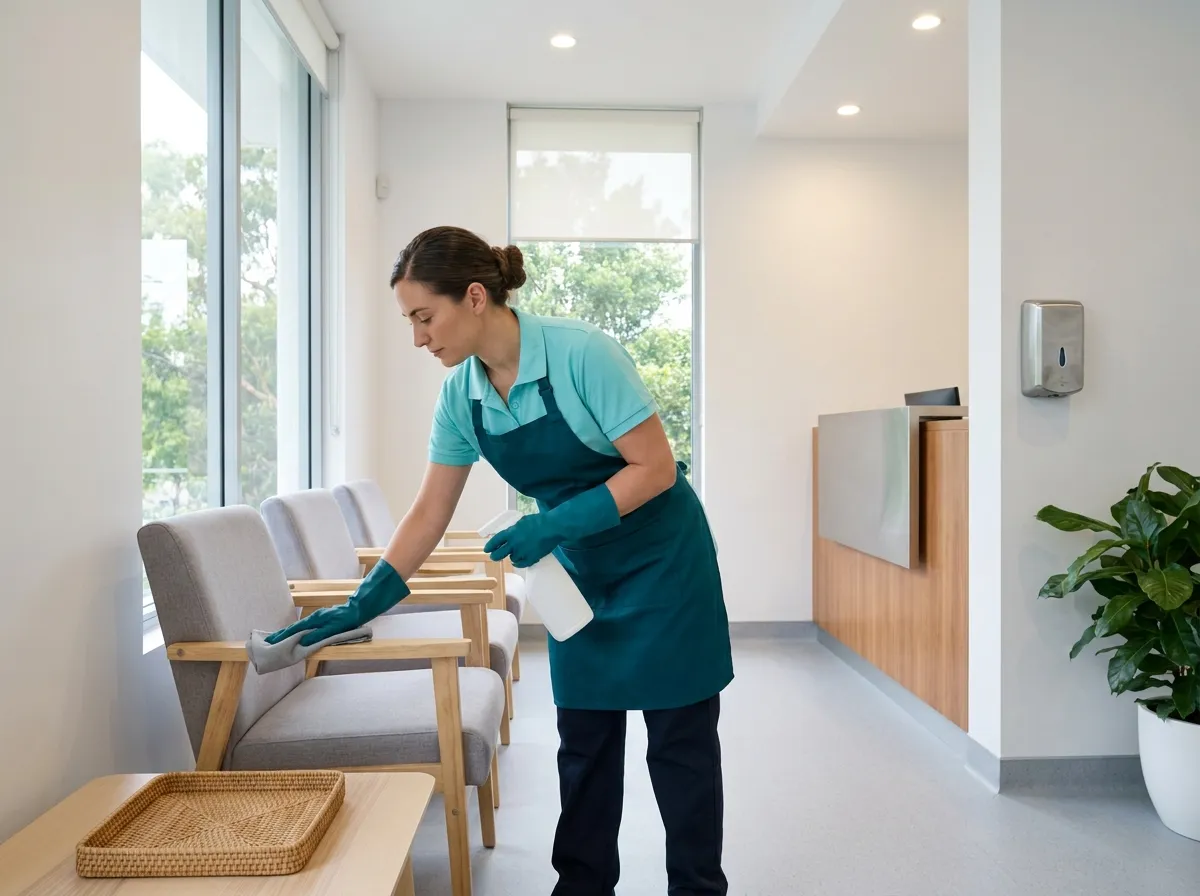
Consulting rooms, treatment rooms, waiting room and reception, staff areas and bathrooms. High-touch surfaces and hard floors every visit, upholstery and vents periodically, and a written scope your practice can attach to its own infection control policy. We clean the environment; your clinical staff clean clinical equipment and segregate clinical waste. That line is drawn in writing before we start.
Request a site quote todayAllied health and clinics
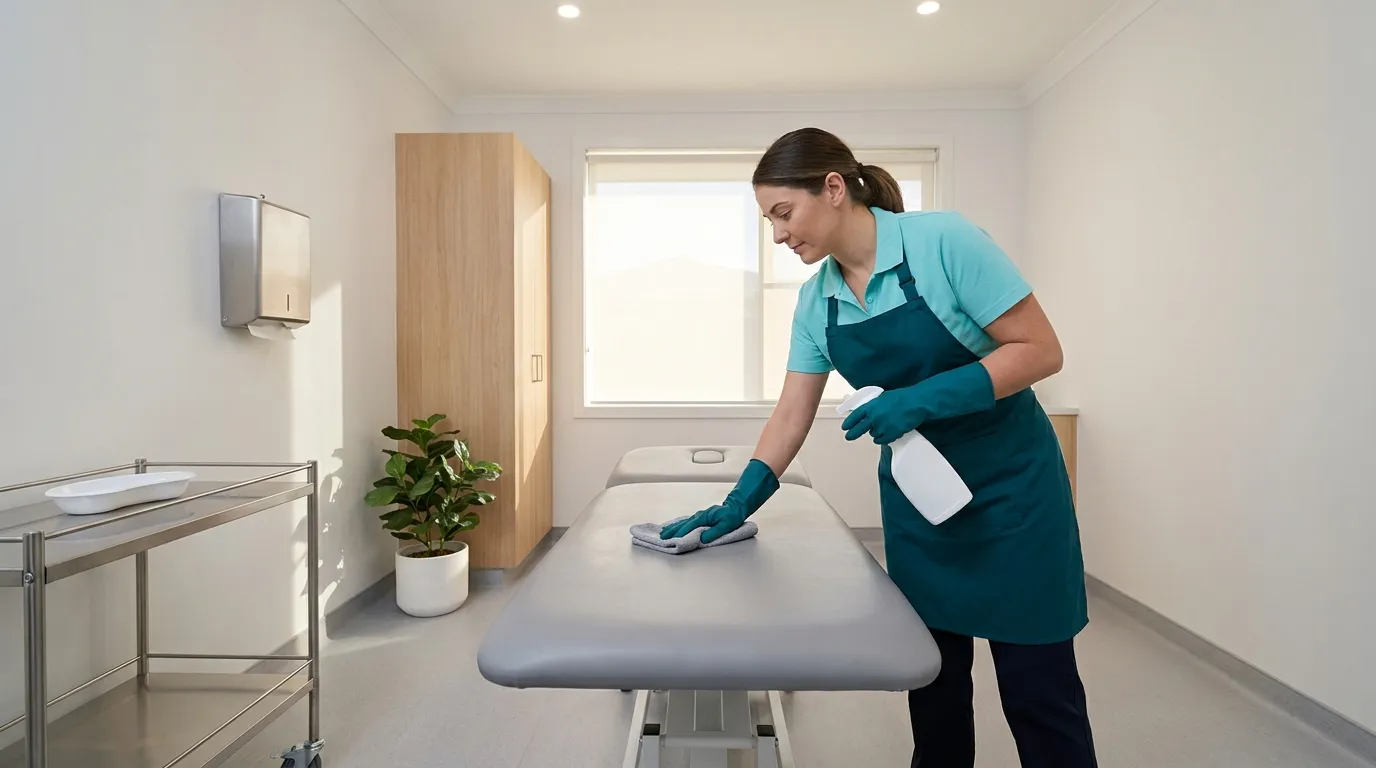
Physio, chiro, podiatry, psychology, massage and day spa rooms. The difference here is upholstery and floor contact: treatment beds, plinths, bolsters and mats take skin contact all day and need disinfecting rather than wiping, and gym and rehab floors get walked on barefoot. We treat those as wet-area surfaces even though the room is dry.
Request a site quote today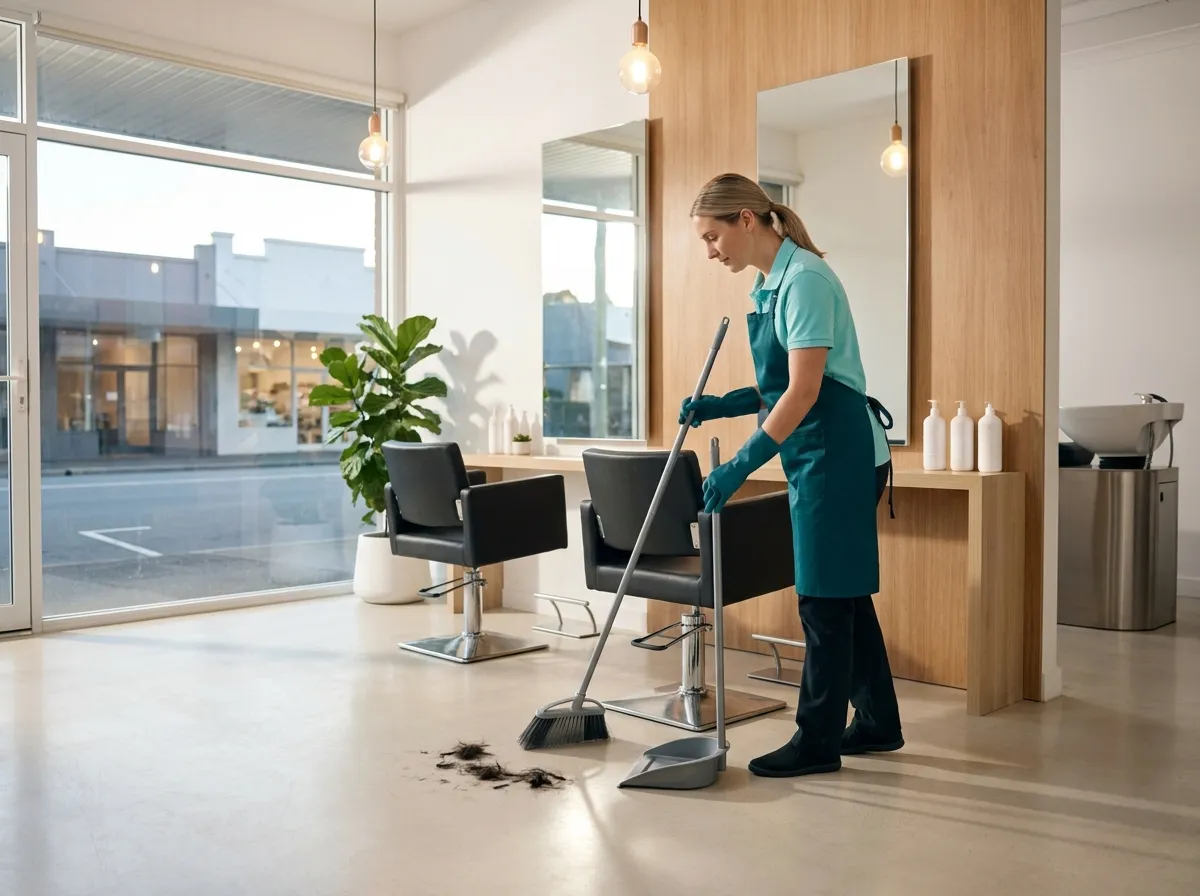
Hair and beauty salons
Salons generate a mess no office scope anticipates: hair everywhere including under and behind everything, colour on floors and basins, wax and product residue, and a basin area that is a wet area whether or not it is tiled. Floors swept and mopped, chairs and dryers wiped down, basins and traps cleaned, mirrors and glass done, and bins that need lining properly rather than tipping.
Request a site quote todayWhat every one of them gets
Four things that are true whether you run a practice, a clinic or a salon.
High-touch, every visit
Door handles, light switches, reception counter, EFTPOS terminal, chair arms in the waiting room, tap handles, the sanitiser dispenser itself and the treatment bed or chair adjustment levers. These are the surfaces that carry infection between people, and they take minutes.
Colour-coded equipment
Separate cloths and mop heads for bathrooms, treatment rooms and general areas, so nothing crosses from a toilet to a treatment bed.
Floors, and the edges of them
Vinyl mopped, coving and the join between floor and wall cleaned rather than skipped, carpet vacuumed including under the waiting room chairs. In a clinic the floor edge is where dust and hair collect, and it is the first thing an accreditation surveyor kneels down to look at.
Dry before you open
Every visit finishes with the floors dry and the room usable. This is not a detail: a damp treatment room floor at 8am is a slip risk for a patient on crutches, and a clinic cannot run its first appointment in a room that is still wet.
Somebody other than your clients audits this
A clinic is the one kind of premises where somebody other than your clients audits your cleaning. An accredited general practice has to show an infection prevention approach that covers the practice environment, not just clinical procedure. A salon offering skin penetration treatments can be inspected by its local council. Neither of those goes well if the only record of what gets cleaned is a verbal arrangement with a contractor.
That is the practical reason to insist on a written scope here rather than anywhere else: it is the document that turns "we have a cleaner" into evidence. It should name each room, the surfaces in it, what they are cleaned with and how often. We write ours to be attached to your own procedures rather than to sit in a drawer, and if your procedures already specify something different from what we would normally do, yours wins.
Other premises we clean
Commercial cleaning for every kind of premises across the Northern Rivers and the Tweed.
- Office cleaning
- Strata and common area cleaning
- Aged care, retirement and seniors
- Construction site
- Hospitality, venues and holiday parks
- Commercial kitchen cleaning
- Schools and childcare centres
- Gyms and fitness studios
- Retail and shopfronts
- Warehouses and industrial sites
- Factories
- Breweries
- Commercial carpet cleaning
- Commercial pressure cleaning
- Commercial cleaning
Where we clean
Across the Northern Rivers, the Tweed and the Southern Gold Coast.
Northern Rivers NSW
- Lismore
- Goonellabah
- Alstonville
- Wollongbar
- Casino
- Kyogle
- Nimbin
- Clunes
- Bexhill
- Dunoon
- Ballina
- East Ballina
- Lennox Head
- Skennars Head
- Wardell
- Evans Head
- Broadwater
- Woodburn
- Coraki
- Bangalow
- Byron Bay
- Suffolk Park
- Mullumbimby
- Brunswick Heads
- Ocean Shores
- New Brighton
- Billinudgel
- Federal
The Tweed
- Murwillumbah
- Tweed Heads
- Tweed Heads South
- Banora Point
- Terranora
- Bilambil
- Bilambil Heights
- Chinderah
- Fingal Head
- Kingscliff
- Casuarina
- Cudgen
- Cabarita Beach
- Bogangar
- Hastings Point
- Pottsville
- Uki
- Burringbar
- Mooball
Southern Gold Coast QLD
- Coolangatta
- Bilinga
- Tugun
- Currumbin
- Palm Beach
- Elanora
- Burleigh Heads
- Burleigh Waters
- Miami
If a town isn't listed, ask us anyway.
Easy to book, fast quoting, cost effective
Managed for you. Set day, set team, a reminder before, a message on the way, and told first when something changes.
Book a walkthrough online, or send a text, ring us or email, whichever suits. We come and look at the premises rather than pricing it off a form.
Commercial work gets priced on the site, because hours on the ground are what set the number. You get a written scope and a price per visit, so you know what you're paying for. Anything outside that scope is quoted before it happens, not added afterwards.
It's cost effective because a written scope is something you can hold us to. You're buying a defined amount of work, on a set day, from the same team each visit. No lock-in term.
How it works
- Tell us about the job.
- We confirm the price and agree a time and access.
- We do the clean, and you get a message when we're on the way.
- If something needs fixing, you hear it from us first.
Working with us on your premises
1. Can you clean between close and open?
Yes, and it is the only way this work makes sense. We clean in the evening after your last appointment or early enough in the morning that everything is dry before your first. Both windows attract penalty rates under the Cleaning Services Award and both appear on the quote with their own price, so you can see what the timing costs.
2. Will you follow our infection control policy?
Yes. Where your policy specifies a product, a method or a frequency, yours wins over our standard scope and we write it in. If your policy needs a particular disinfectant used a particular way, tell us at the walkthrough and it goes on the scope rather than into someone’s memory.
3. Do you clean treatment beds and clinical equipment?
We clean and disinfect treatment bed and chair upholstery, plinths, bolsters and the frames they sit on, because those are environmental surfaces. We do not clean clinical equipment, instruments, autoclaves or anything that touches a patient in a procedure. That is clinical staff work under your own procedures, and it stays there.
4. What about hair, colour and wax in a salon?
It is why a salon needs its own scope rather than an office one. Hair travels further than anyone expects and collects behind and under everything, so floors get swept before they are mopped and the edges get done rather than the middle. Colour is treated as a stain on the day, not next week. Basins and traps are cleaned, and wax residue comes off with the right solvent rather than a scourer.
5. Are your cleaners police-checked?
Yes. Our cleaners are employed by TLB rather than subcontracted, so there is no third party between you and the person who attends.
6. What happens if I get in touch?
We walk the premises after hours with you, room by room, and ask what your own procedures require. Then you get a written scope naming each room and its surfaces, a price per visit and an after hours option shown separately. No obligation, and nothing to sign on the night.
Medical office cleaning services, common questions
1. How much does medical or clinic cleaning cost?
It depends on how many consulting or treatment rooms there are, how many bathrooms, how much of the floor is vinyl versus carpet, and whether the visit has to happen inside a narrow window between close and open. A three-room clinic and a ten-room practice are different jobs. That's why we quote rather than publish a flat rate that would be wrong for most practices. Tell us the basics and you'll have a price back quickly, with no obligation attached to it.
2. What is the difference between cleaning and disinfecting?
Cleaning physically removes soil, and disinfecting kills what is left. The order matters and it is where most cleaning goes wrong: spraying disinfectant onto a surface that still has organic soil on it largely wastes the disinfectant, because soil inactivates it. Surfaces get cleaned first, then disinfected, and the disinfectant is left wet for its stated contact time rather than wiped straight off.
3. Who is responsible for clinical waste in a practice?
The practice is. Clinical and related waste has to be segregated at the point it is generated, by the clinical staff who generate it, into the correct containers, and then collected and disposed of by a licensed waste contractor. A general cleaning contractor handles general waste and recycling only. Anyone offering to take your sharps away as part of a cleaning contract is not licensed to.
4. How often should a clinic be cleaned?
Daily at minimum for any premises seeing patients or clients, with high-touch surfaces, bathrooms and floors done every visit. Treatment surfaces are cleaned between patients by clinical staff, which is separate from the daily environmental clean. Carpet extraction, upholstery, vents and high dusting are periodic. A busy salon usually needs daily as well, driven by hair and product rather than by infection risk.
5. Do salons have cleaning regulations in NSW?
Some do. Premises offering skin penetration treatments, meaning tattooing, piercing and certain beauty procedures that break the skin, are regulated under NSW public health legislation and can be inspected by the local council, with requirements covering cleanliness, sterilisation and waste. A hairdressing-only salon has no equivalent scheme but still has work health and safety duties. Check with your council rather than assuming which category you are in.
6. Should a cleaner have their own insurance to work in a clinic?
Yes, and you should sight the certificate and its expiry date rather than take the word for it. Public liability cover is what protects your practice if a contractor damages equipment or a patient is injured because of their work, and workers compensation covers the cleaner themselves. Ask for both, and ask whether the people attending are employees of the company or subcontractors, because that changes who is actually covered.
Medical, clinic and salon cleaning
Start with an after-hours walkthrough.
Room by room, against your own procedures. Then a written scope you can attach to your policy, and a price per visit.